
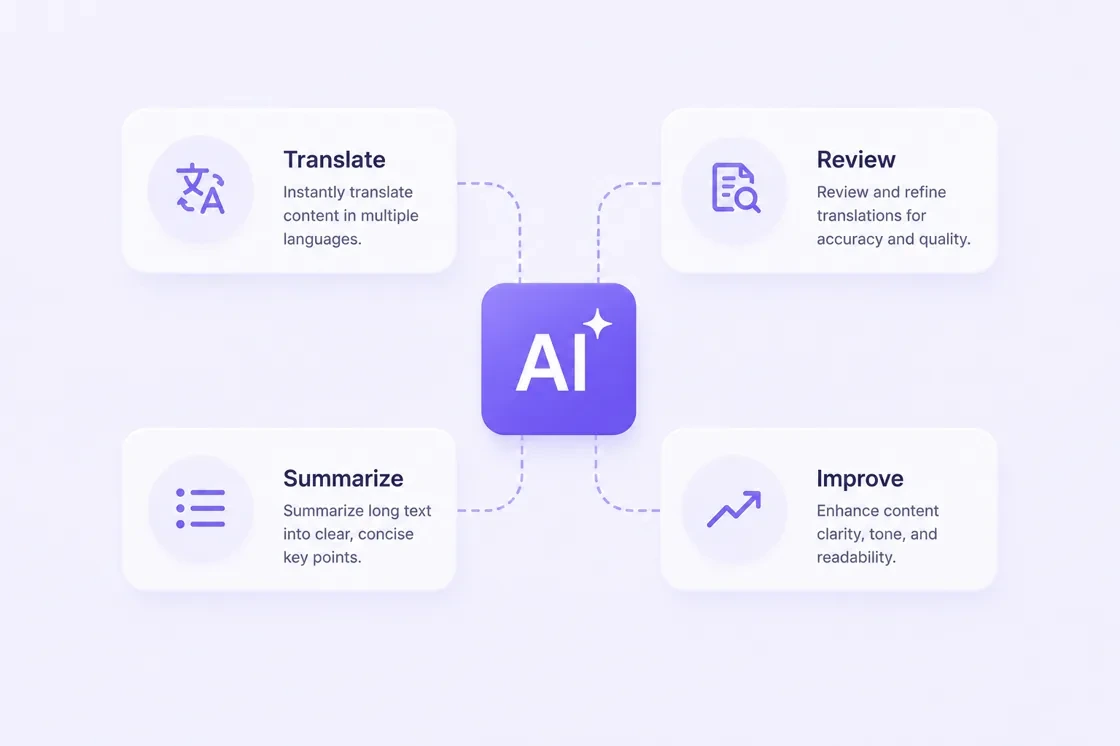
In the fast-evolving world of global business, the ability to communicate across borders is no longer just an advantage, it is a necessity. As companies strive to reach international audiences, the debate over how to handle translation has intensified. On one side, we see the rise of Large Language Models (LLMs) like ChatGPT, which have dazzled the public with their conversational fluidity. On the other hand, we have specialized platforms like Wordbeam, designed specifically for the rigorous demands of professional localization.
If you are a business owner or a project manager, the choice between these two is about more than just convenience. It is about architectural integrity, long-term scalability, and the survival of your brand identity. While ChatGPT is an impressive technological feat, it was never built for the complex "translation ecosystem." Here is why Wordbeam stands as the superior choice for your professional translation work.
The Generative vs. The Structural
To understand why Wordbeam outperforms generalist AI, we must first look at the underlying engines. ChatGPT is a generative model. Its primary directive is to predict the next logical word in a sequence to maintain a conversation. It is inherently creative, fluid, and improvisational. While this makes it excellent for writing a quick email or a creative blog post, it makes it fundamentally unpredictable in a professional localization context.
Wordbeam, by contrast, is a structural system. It is built to operate within a framework of rules, constraints, and historical data. In professional translation, the "correct" answer isn't the most creatively written one—it is the one that follows your brand’s glossary, respects your software's technical variables, and maintains total consistency across thousands of strings. Wordbeam provides the guardrails that ChatGPT lacks by default.
Why Is Wordbeam The Professional’s Choice?
When you use ChatGPT for translation, you are essentially "chatting" with your content. You have to manually manage files, ensure you haven't stripped away essential code, and hope the AI didn't hallucinate a mistranslation that could be costly to fix later. Wordbeam removes this manual friction entirely.
1. Precision and Consistency
In professional localization, terminology management is non-negotiable. If your brand refers to a feature as a "Dashboard," you cannot have half your app calling it a "Control Panel." ChatGPT, in its generative nature, may choose different words in different sessions based on what it perceives to be "natural." Wordbeam utilizes centralized glossaries and Translation Memory (TM) to enforce your specific terminology with robotic precision.
2. Protecting Your Technical Assets
Software localization is fraught with technical risks. Modern applications are filled with placeholders, variables, and HTML tags, often looking like {username} or <div>. A generalist AI like ChatGPT often views these as natural language and may inadvertently "translate" or "fix" them, resulting in broken application logic or visual bugs. Wordbeam uses intelligent masking to protect your code, ensuring that your developers don't spend hours debugging translation-induced errors.
3. Audit Trails and Governance
Business content requires accountability. When a legal, medical, or technical document is translated, you need to know exactly who changed what and when. Wordbeam provides a full audit trail, version control, and review layers. ChatGPT is a "black box", once the output is generated, the history of that specific linguistic decision is lost in a sea of past chat logs.
Feature Comparison between ChatGPT vs WordBeam
| Feature | ChatGPT (Generalist AI) | WordBeam (Specialized System) |
| Context | Single-session memory | Permanent, centralized TM/Glossary |
| Code Integrity | High risk of breaking tags | Guaranteed placeholder protection |
| Consistency | Low (Varies by prompt/session) | High (Enforced by rules) |
| Scalability | Manual/Disconnected | Automated/Connected to CMS/Repo |
| Accountability | None (Static output) | Full audit logs and version history |
| Integration | Limited to copy-paste | API-first, native CMS connectivity |
The Risk of Unchecked AI Content
The most dangerous aspect of relying on general-purpose AI is the phenomenon of "hallucination." Because ChatGPT is designed to generate content that looks correct, it can invent facts, misinterpret cultural nuances, or provide incorrect terminology with complete confidence. In a marketing blog, this might be a minor inconvenience. In a user interface or a legal manual, it is a liability.
Wordbeam provides a governed environment where AI, if used is applied as a tool under supervision, not as the final decision-maker. It allows for Human-in-the-Loop (HITL) workflows, ensuring that professional linguists can review and validate every segment before it ever hits your live production environment.
Why You Should Move Your Workflow
If you are currently relying on manual file swapping or ad-hoc chat sessions with AI, you are operating in a state of "technical debt." You might be saving money on translation in the short term, but you are accumulating costs in quality assurance, developer time, and potential brand damage.
Wordbeam is designed to be the backbone of your global content strategy. It connects directly to your content repositories, automates the routing of tasks to your translators, and ensures that every language version of your site is a mirror image of your brand standards.
Conclusion
The future of translation is not about choosing between human or machine; it is about building a system that leverages the best of both. ChatGPT is a tool for ideas, but Wordbeam is a tool for execution.
By moving your translation work to a platform built for professional precision, you stop managing chaos and start managing growth. You gain the ability to scale into new markets with the confidence that your app will work, your terms will be consistent, and your brand will sound exactly the way you intended, regardless of the language. It is time to treat your translation workflow with the seriousness that your business deserves. Stop "chatting" with your translations start managing them with the precision of Wordbeam.