
Many organizations begin their journey into global markets with a simple, familiar approach. They rely on email threads, shared folders, and massive, rows-and-columns documents to track linguistic assets. While this might suffice for a one-off project or a single landing page, it quickly becomes a fragile foundation for any serious business. If you are still relying on manual tracking, you are likely losing time, money, and accuracy. It is time to consider how a dedicated translation management system can transform your global operations.
The Hidden Costs of Manual Processes
Managing content via manual files creates a series of invisible bottlenecks. As your project volume grows, the complexity of managing file versions, translator feedback, and final deployment increases exponentially. When you use spreadsheets to handle your translation workflow, you aren't just managing data; you are essentially performing a high-stakes balancing act without a safety net.
The risk of error in manual systems is immense. A translator might overwrite a segment from a previous version, or a project manager might accidentally send an outdated file to the wrong vendor. These aren't just minor inconveniences; they are operational failures that erode trust with your international audience. Relying on these legacy methods effectively turns your team into manual data entry clerks rather than language experts.
Precision Through Automation
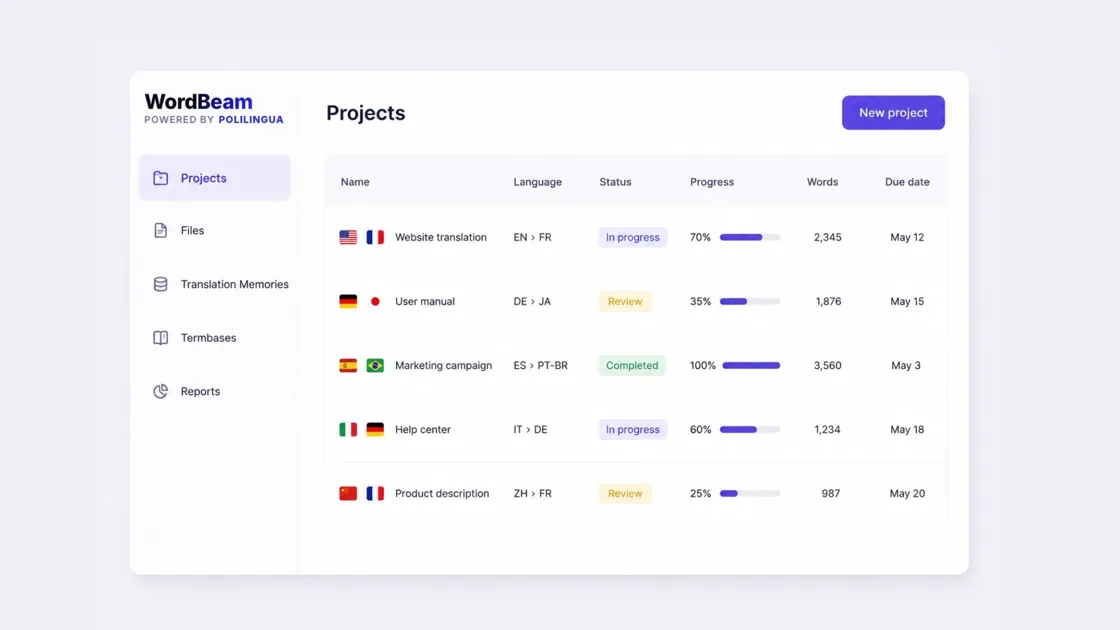
Transitioning to a professional translation workflow management system is the most significant step toward scalability. These platforms do not just organize files; they orchestrate the entire lifecycle of a project. Instead of chasing down updates in your inbox, you gain a centralized dashboard that provides real-time visibility into every phase of the process.
Modern solutions allow you to automate repetitive tasks, such as file routing, status tracking, and notification alerts. By removing the need for manual file handling, you minimize human error and free up your team to focus on high-value tasks, such as transcreation and brand messaging.
The Power of Context and Consistency
One of the greatest weaknesses of spreadsheet-based management is the lack of context. Translators working in a grid view often miss the nuance of how a string will appear on a live site. This is where a robust website translation platform proves its worth. These systems offer in-context previews, allowing linguists to see exactly where a string fits, ensuring that character limits, gender agreement, and cultural nuances are handled correctly the first time.
Consistency is another casualty of manual workflows. Without a centralized repository of approved terminology, different translators might interpret the same phrase in multiple ways, leading to a fragmented brand identity. An integrated translation project management system ensures that every team member works from the same glossary and translation memory, creating a unified brand voice across every language you support.
Leveraging Modern Technology
The industry is evolving rapidly, and staying competitive requires embracing the latest innovations. Whether you are looking for an AI powered translation management system to accelerate your turnaround times or a computer assisted translation tool that helps your team maintain high standards, the right technology stack is vital.
Many companies are now seeking a translation platform online to facilitate collaboration across time zones. This shift toward cloud-based environments means your resources are always accessible, secure, and up-to-date. By utilizing an online translation management system, you ensure that stakeholders in different departments from marketing to product development can contribute to the workflow without constant back-and-forth communication.
Selecting the Right Partner
When exploring translation management system examples, look for platforms that integrate seamlessly with your existing infrastructure. A true cms translation workflow should be invisible, pushing and pulling content directly from your backend without requiring manual exports or imports.
If you are currently evaluating your options, consider these three pillars of success:
-
Automation: Can the tool handle the heavy lifting of routing and notifications?
-
Centralization: Is there a single source of truth for all your linguistic assets?
-
Integration: Does it connect with your existing tech stack (CMS, git repositories, etc.)?
Finding the best translation management system is less about choosing the one with the most features and more about finding the one that aligns with your specific growth trajectory. Whether you are using a simple online translation platform for internal communications or a complex translation platform for high-volume enterprise needs, the goal remains the same: reducing friction.
Future-Proofing Your Strategy
The decision to move away from spreadsheets is about more than just convenience; it is about future-proofing your business. Manual methods cannot scale, and in a global market, scalability is everything. By implementing an online translation tool, you are setting the stage for faster launches and higher quality outputs.
As you look for the best translation tool for your specific requirements, remember that a machine translation tool can be a powerful accelerator when paired with human oversight. Integrating these technologies into your translation workflow management software allows you to balance speed and quality, giving you a distinct advantage over competitors who are still stuck in the past.
Choosing the right translation tool is the first step toward reclaiming your team's productivity. It is time to stop managing files and start managing projects. Move your operations to a dedicated translation platform, and watch how quickly your international projects begin to run with newfound precision and ease.
Are you ready to see how a professional system can streamline your current processes and remove the manual bottlenecks in your workflow?