
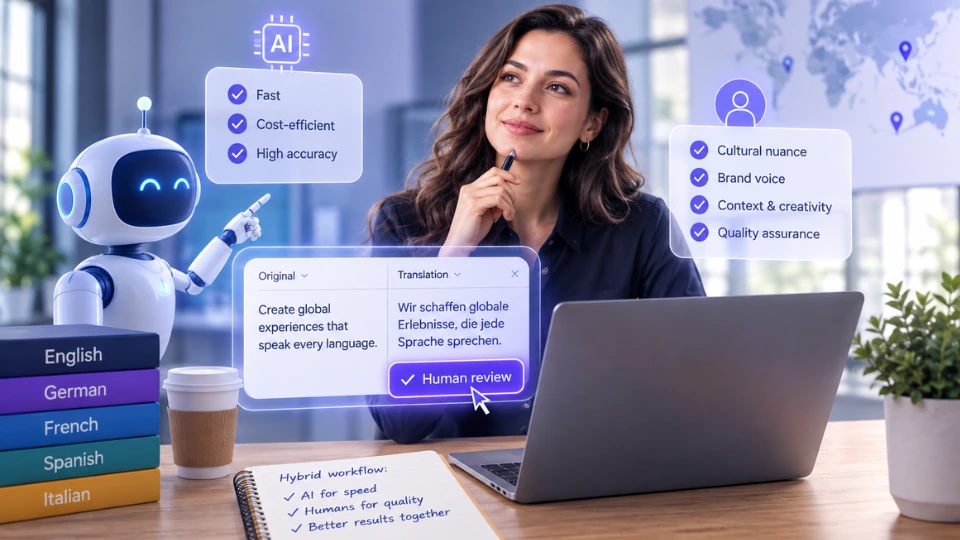
Every localization team is asking the same question in 2026: can AI translation finally replace human translators, or is that still years away? The honest answer is neither extreme. The teams shipping the fastest, most accurate multilingual content aren't choosing AI or humans, they're combining both inside a single workflow, and letting a translation management system (TMS) decide which one handles which segment.
Where AI translation actually stands in 2026
AI machine translation has made enormous progress. Benchmarks across major language pairs now show average accuracy around 94.2%, with user satisfaction scores of 4.3 out of 5. That's a dramatic jump from the machine translation of even five years ago. The market reflects that confidence: the global AI translation market was valued at $1.47 billion in 2023 and is projected to reach $12.1 billion by 2032, growing at a 26.4% CAGR, with AI tools expected to capture roughly 40% of the broader $60 billion translation services industry.
But the accuracy number hides an important detail. Errors don't spread evenly, they cluster exactly where the stakes are highest: negated obligations in legal contracts, dosage figures in medical content, and reversed safety warnings in technical documentation. For lower-resource language pairs such as Farsi or Armenian, accuracy can still drop to 55–70%. That's why 73% of enterprises now use AI translation internally, but only 19% trust it for external or regulated communication without human review.
AI, human, and hybrid: a side-by-side comparison
| Factor | Pure AI Translation | Pure Human Translation | Hybrid (TM + AI + Human QA) |
|---|---|---|---|
| Speed | Near-instant | Slow, limited by translator bandwidth | Fast first pass, targeted human review |
| Average accuracy | 82–96% depending on language pair | 98–99% | Approaches human quality on reviewed content |
| Cost per word | Lowest | Highest | Reduced 20–60% via TM reuse and AI pre-translation |
| Consistency & terminology | Weak without a glossary | Strong if enforced manually | Strong, enforced automatically |
| Best for | High-volume, low-risk content | Legal, medical, brand-critical copy | Everything, routed by risk level |
| Regulatory/compliance fit | Risky unsupervised | Safe | Safe, with full audit trail |
Matching content type to the right approach
Not all content carries the same risk if a translation is slightly off. A marketing headline that's 90% right can be edited in seconds; a mistranslated clause in a legal contract cannot. Mapping content type to translation leverage helps teams decide where to automate and where to slow down.
| Content type | Typical TM leverage | Recommended approach |
|---|---|---|
| Software / UI strings | 40–60% | AI pre-translate, light human review |
| Technical documentation | 30–50% | AI + glossary enforcement, human QA pass |
| Marketing & campaigns | 10–30% | Human-led, AI for drafts only |
| Legal & compliance | Low, but high repetition of clauses | Human translation, AI for reference only |
| Customer support replies | High, repetitive | AI-first with spot-check review |
The financial case for translation memory
Translation memory (TM) remains one of the highest-ROI tools in localization, and it's arguably more valuable now than ever, because it gives AI engines context instead of a blank page. A well-maintained TM can cut translation costs by 20–40% on repetitive content, and in some documented cases by up to 60–70% on revised or repeat material. Kaspersky reported cutting its localization budget by roughly 10x over four years of consistent TM use, and industrial manufacturer Beumer Group documented a 30% reduction in translation costs after adopting translation memory. Separately, translation memory has been shown to increase translator productivity by 10–60%, freeing linguists to focus on the segments that actually need human judgment.
Why orchestration matters more than the engine you pick
The mistake many teams make is treating "AI vs. human" as a single, company-wide decision. In practice, the right choice changes segment by segment, and even engine by engine, GPT, Claude, DeepL, and Grok each perform differently depending on language pair and content type. This is exactly the problem a modern TMS is built to solve: instead of copy-pasting between AI tools and spreadsheets, a translation memory and glossary feed every engine the same approved terminology, real-time QA flags tag, number, and length errors before a human ever opens the file, and reviewers are routed automatically based on risk, not guesswork.
The takeaway
AI translation in 2026 is good enough to be the default first step for most content, but it's not yet good enough to run unsupervised on anything regulated, brand-critical, or high-stakes. The teams pulling ahead aren't picking a side. They're using translation memory and multi-engine AI to handle volume and consistency, while keeping human review focused on the small fraction of content where accuracy actually determines the outcome and running the whole thing through one connected workflow instead of a dozen disconnected tools.