
Machine translation has improved more in the last ten years than in the previous sixty. Neural systems arrived around 2016, large language models followed, and today almost every translator and localization team uses a machine translation tool somewhere in their workflow. Yet the same engine that produces a flawless paragraph can mistranslate a legal term, invert a negation or ignore your client's approved terminology without any warning.
Choosing a machine translation tool for professional work is therefore less about finding the "smartest" engine and more about building a process where machine output is fast, controlled and checked. This guide explains what to evaluate and how to use MT without putting quality at risk.
What Is a Machine Translation Tool?
A machine translation tool is software that automatically converts text from one language into another without a human writing the translation. Consumer tools such as free web translators are designed for quick understanding. Professional tools are designed for production, which means they connect to translation memory, respect glossaries, preserve formatting tags and protect confidential content.
Modern MT comes in two main flavors. Dedicated neural machine translation engines, such as DeepL or Google's translation models, are trained specifically for translation. Large language models such as GPT, Claude or Grok are general purpose systems that can translate very well when given clear instructions and context. Both have strengths, and the best results usually come from using more than one.
How Good Is Machine Translation Today?
Quality is now high for many major language pairs. In the preliminary WMT24 machine translation ranking, published for one of the field's most respected annual benchmarks, large language models such as Claude 3.5 Sonnet and GPT-4 placed among the top systems across multiple language pairs. The same report includes two important caveats. Automatic quality metrics are limited and biased, so human evaluation remains the real test, and none of the evaluated languages were low resource languages, where performance is usually weaker.
In other words, MT is excellent at producing a fluent first draft in common language pairs. It is not a guarantee of accuracy, especially in specialized domains or less common languages.
Six Criteria for Choosing a Machine Translation Tool
| Criterion | What to check | Why it matters |
|---|---|---|
| Engine choice | Access to several engines, not just one | Different engines win on different language pairs and content types |
| Terminology control | Glossary terms enforced in the output | Prevents brand names and legal terms from drifting |
| Memory integration | TM matches used before MT | Approved human translations always take priority |
| Tag handling | Formatting and placeholders preserved | Avoids broken files and manual repair |
| Data privacy | No training on your content, clear retention rules | Protects client confidentiality and contracts |
| Human review step | Built in editing, QA and revision workflow | Turns a draft into a deliverable translation |
Why One Engine Is Rarely Enough
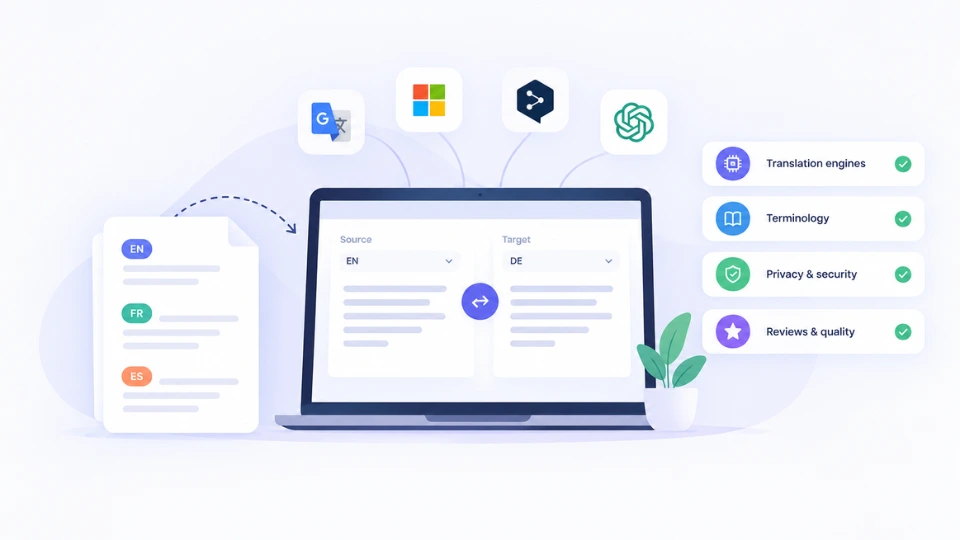
Translators who test engines side by side quickly notice that no single system wins everywhere. One engine handles German marketing copy beautifully but struggles with Japanese UI strings. Another follows instructions about tone and formality well but occasionally adds content that was not in the source. Multi engine routing solves this by sending each segment, or each language pair, to the engine that performs best for it, and letting the translator compare outputs when it matters.
This is the approach behind the WordBeam machine translation tool, which routes segments across GPT, Claude, Grok and DeepL, injects glossary and memory context, and enforces approved terms instead of silently overwriting them.
The Risks of Raw Machine Translation
Publishing unedited machine output is where most problems start. The typical failures are subtle rather than obvious, which is exactly what makes them dangerous.
- Fluent but wrong. LLM output reads naturally, so errors in meaning are harder to spot than clumsy grammar.
- Terminology drift. The same term may be translated three different ways in one document.
- Omissions and additions. Short negations, conditions or numbers can disappear or be invented.
- Tone mismatch. Formal and informal address, such as Sie and du in German, may switch mid text.
- Confidentiality. Free consumer tools may store or reuse what you paste into them.
For legal, medical, financial or certified documents, these risks are unacceptable without professional review. Even the international quality standard for translation services, ISO 17100, explicitly places raw machine output plus post-editing outside its scope, and a separate standard, ISO 18587, governs how post-editing must be done.
A Professional Workflow for Using MT Safely
- Pre-translate with translation memory so approved human translations are used first.
- Send only unmatched segments to the best engine for the language pair, with glossary context applied.
- Have a qualified linguist post-edit the output, focusing on meaning, terminology and tone.
- Run automated QA for numbers, tags, punctuation and term consistency.
- Store the approved result in memory so the next project improves.
If you want a deeper look at step three, our guide to machine translation post-editing explains light and full post-editing in detail. Teams that need all of these steps in one place usually move to an AI powered translation management system rather than juggling a browser translator, a spreadsheet glossary and email.
Frequently Asked Questions
What is the best machine translation tool?
There is no single best engine for every language pair. Professional teams get better results by comparing several engines and choosing per language and content type.
Can machine translation replace human translators?
Not for content where accuracy matters. MT speeds up drafting, but a qualified human is still needed to verify meaning, terminology and cultural fit.
Is it safe to use free online translators for client work?
Usually not. Check the terms of service, because many free tools may retain submitted text. Professional tools offer contractual privacy guarantees.
Used well, a machine translation tool is a powerful accelerator. Used alone, it is a liability. The difference is the workflow, and the human expertise built into it.