
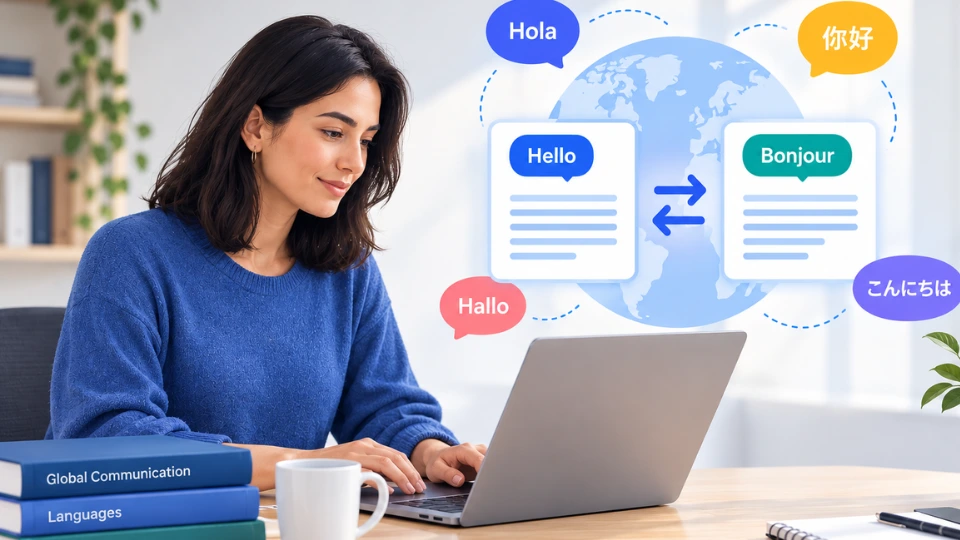
Translation is the process of converting written text from one language, the source language, into another, the target language, while preserving meaning, tone, and intent. It is one of the oldest professional crafts in the world, yet it has never been more central to global business than it is today: every website, app, contract, product label, and marketing campaign that crosses a border depends on it.
At its core, translation is not word for word substitution. A translator has to understand context, cultural nuance, register (formal versus casual), industry terminology, and the purpose of the text before choosing how to render it in another language. A legal contract and a social media caption require completely different translation approaches, even if they are the same length. The translator's job is closer to careful reconstruction than direct substitution, choosing words that carry the same weight and function inside a completely different linguistic system.
A Short History of Translation
People have translated texts for as long as they have traded, governed, and worshipped across language boundaries. Religious texts, treaties, and trade agreements were among the earliest documents translated between cultures, often by scholars who spent years mastering both languages and the subject matter itself. What has changed is scale and speed: a task that once took a single scholar months now routinely involves distributed teams, shared translation memories, and software that manages thousands of segments across dozens of languages at once. The underlying skill, understanding meaning well enough to recreate it faithfully elsewhere, has not changed at all.
How Translation Actually Works
Professional translation today rarely happens in a blank document. Most translators and translation teams work inside a Translation Management System (TMS) paired with a CAT (Computer Assisted Translation) editor, which brings several advantages:
- Translation memory (TM): Previously translated sentences are stored and reused, so the same phrase is never translated from scratch twice, improving both speed and consistency.
- Terminology management: A glossary of approved terms ensures brand and industry vocabulary stays consistent across every document and translator.
- Quality assurance checks: Automated checks catch missing numbers, inconsistent terminology, or untranslated segments before content goes live.
- Machine translation assistance: AI generated drafts can be used as a starting point, which a human translator then reviews and refines, a process known as post editing.
These tools do not replace the translator's judgment. They remove the repetitive parts of the job so a linguist can spend their time on the sentences that actually need careful thought, the ones with ambiguity, wordplay, or cultural nuance that no glossary can fully resolve.
Translation vs. Localization
These two terms are often used interchangeably, but they are not the same thing. Translation converts language. Localization goes further, adapting currency formats, date formats, imagery, legal requirements, and cultural references so content feels like it was created for that market, not just translated for it. A well run translation workflow is the foundation that makes proper localization possible, though localization decisions, such as which images to swap or which legal disclaimers to add, usually sit with in market stakeholders rather than the translator alone.
Why Accurate Translation Matters for Business
Poor translation is not just an embarrassment, it is a business risk. Mistranslated legal terms can void contracts. Inaccurate medical or technical documentation can create safety issues. Awkward marketing copy can damage brand trust in a new market before a company has a chance to build it. Investing in a proper translation workflow, meaning the right tools, qualified linguists, and a consistent process, pays for itself many times over compared to the cost of fixing mistakes after launch. Companies that treat translation as an afterthought often end up paying for the same content twice: once to translate it, and again to fix it after a market complains.
Common Mistakes Businesses Make with Translation
The most common mistake is treating translation as a single event rather than an ongoing process. Content gets translated once for a launch, then updated in the source language for months or years without anyone revisiting the translated versions, so the different language editions of a website or app slowly drift apart. A second common mistake is skipping a review step entirely and publishing machine translated content without any human check, which can work for low stakes internal notes but is risky for anything customer facing. A third is using different translators or agencies for different languages with no shared glossary, so the same product name or feature ends up described three different ways across three markets.
Getting Started with a Translation Workflow
Whether you are translating a single document or managing ongoing multilingual content across dozens of languages, the same principles apply: keep a translation memory so nothing is translated twice, maintain a glossary so terminology stays consistent, and build in a quality review step before anything ships. Start small if you need to. Even a single shared glossary and a lightweight review step will noticeably improve consistency compared to sending files back and forth over email. A modern translation management platform handles all three automatically, turning translation from a one off task into a repeatable, scalable process that grows with your content instead of becoming harder to manage as it grows. Over time, the translation memory itself becomes a real asset: the more content a team translates through the same system, the faster and cheaper future projects become, since fewer sentences ever need to be translated completely from scratch.