
Ask ten freelance translators how they set their rates and you will get ten different answers, several of them contradictory, and at least two based on a number someone quoted in a forum years ago. Pricing is the part of freelancing that translation school rarely covers, yet it decides whether a genuinely skilled translator earns a living wage or quietly underprices themselves for a decade. This guide breaks down how translation rates actually work in 2026, where translation memory discounts come from, and how to price your work so speed earns you more rather than less.
The Three Ways Translation Work Gets Priced
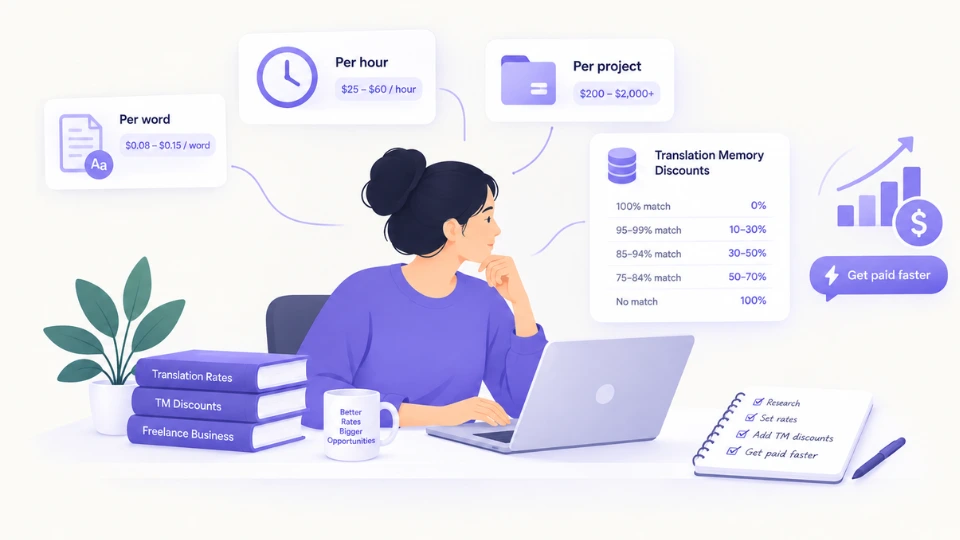
Most translation work is billed one of three ways, and each rewards a different kind of project. Per-word pricing is the industry default for standard document and content translation, since it scales cleanly with volume and is easy for both sides to estimate in advance. Per-hour pricing suits work where output cannot be measured in words alone, such as transcreation, heavy desktop publishing, or editing someone else's translation where the value is in judgment rather than volume. Per-project pricing works best for well-defined, recurring jobs, such as a monthly newsletter or a fixed set of product pages, where both sides already know roughly how long it takes and want to skip re-negotiating every cycle.
According to the U.S. Bureau of Labor Statistics, demand for interpreters and translators is projected to keep growing faster than the average occupation through the rest of the decade, which is worth keeping in mind when a client insists your rate is too high. Growing demand is not a reason to undercharge.
Where Translation Memory Discounts Come From
If you work with agencies or a CAT tool, you have almost certainly seen a rate grid based on match percentages. This confuses newer translators more than almost anything else in pricing, so it is worth explaining plainly. A translation memory stores every segment you have translated before. When a new document comes in, the tool checks each new segment against that memory and reports how closely it matches something you already translated, from a 100 percent exact repeat down to segments with no match at all.
| Match type | What it means | Typical rate |
|---|---|---|
| No match | Brand new segment, no memory overlap | Full per-word rate |
| Fuzzy match, 75 to 94 percent | Similar segment exists, needs real editing | 50 to 70 percent of full rate |
| Fuzzy match, 95 to 99 percent | Near-identical segment, minor edits only | 25 to 40 percent of full rate |
| 100 percent match / repetition | Exact segment already translated | 10 to 20 percent of full rate, or a small review fee |
The logic is fair when applied honestly, a segment you can reuse with two small edits genuinely takes far less time than one you are translating cold. The part translators should push back on is when a client or agency applies steep TM discounts using a shared or vendor memory you did not build, since the time savings that justify the discount only exist because of memory you personally accumulated over past projects. Whose memory it is should factor into whether a discount is reasonable at all.
Setting Your Base Rate
Work backward from the income you need, not forward from what a directory lists as average. Decide on a target hourly income, track how many words you realistically translate per hour in your language pair and subject area once quality is accounted for, and divide to get your baseline per-word rate. Specialized fields such as legal, medical or patent translation justify a meaningfully higher rate than general content, because the research and precision required per word is genuinely higher, not because the market simply allows it. Revisit the number at least once a year. A rate that felt fair two years ago is quietly a pay cut today once you account for how much faster you have gotten and what your time is actually worth now.
Getting Paid for the Speed You Actually Have
The frustrating part of per-word pricing is that it does not reward speed on its own, a faster translator using the same tools as a slower one earns the same per word for finishing sooner. The way around this is not to work faster on the same tools, it is to reduce the time each word actually costs you so your effective hourly rate rises even while your quoted per-word rate stays market-competitive. This is where the right CAT editor earns its cost back quickly, real-time translation memory lookups, term base consistency checks, and side-by-side AI drafts mean fewer manual lookups and fewer second passes for the same segment. A translation memory that stays fully yours, rather than living inside a client's locked platform, also means the leverage you build on one project keeps paying you back on the next one, instead of resetting every time you start with a new client.
Billing matters here too. Pay-as-you-go tools with no per-seat fees and transparent pricing keep more of what you charge in your own pocket rather than a platform's, which is a quieter but very real part of what your effective rate actually ends up being once tool costs are subtracted.
The Bottom Line
There is no single correct translation rate, only a rate that reflects your actual skill, speed and specialization, priced honestly against the time a job really takes. Understand how match-based discounts work so you can evaluate them instead of accepting them blindly, revisit your base rate regularly, and invest in the parts of your workflow that quietly compound your speed over time rather than only in the ones that look impressive on a single project.