
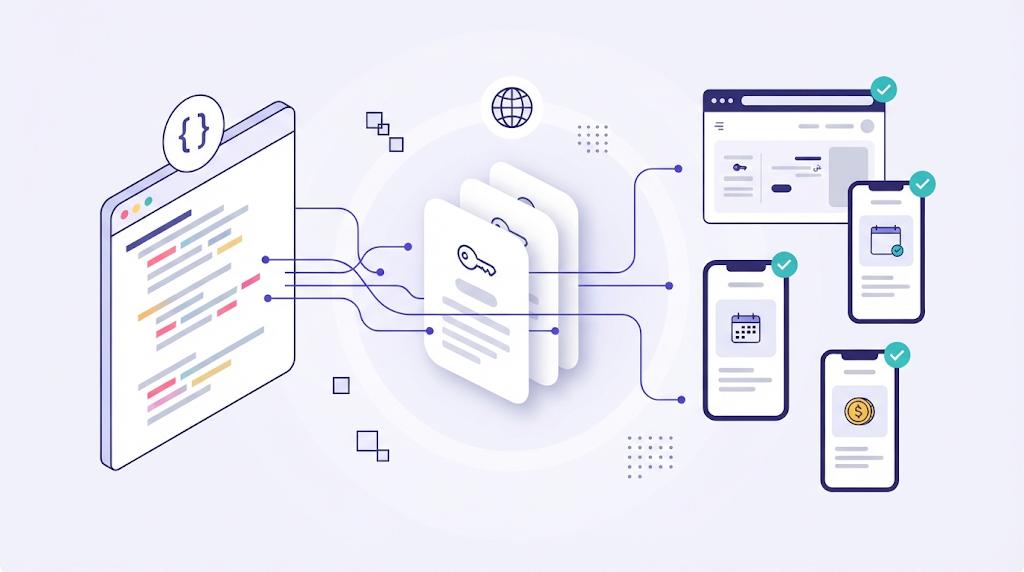
Internationalization and localization are often used as if they meant the same thing. They do not, and confusing them is expensive. A product that was never internationalized can be translated, but every new language becomes a mini engineering project, full of truncated buttons, broken dates and strings buried in code. A product that was internationalized properly can add a language in days.
This guide explains the difference between internationalization and localization, why the abbreviations i18n and l10n exist, and how both fit into a modern software localization workflow.
The Short Answer
Internationalization is preparing a product so it can be adapted to any language or region. Localization is the adaptation itself for one specific market. The W3C Internationalization Activity describes internationalization as designing and developing content or software so that localization becomes easy, and localization as adapting it to the language, cultural and other requirements of a target market, also called a locale.
Put simply, internationalization is done once, by engineers, in the product. Localization is done for every market, by translators, reviewers and local experts.
Why i18n and l10n?
The abbreviations are numeronyms. In "internationalization" there are 18 letters between the first i and the final n, so it becomes i18n. In "localization" there are 10 letters between the l and the n, so it becomes l10n. You may also see g11n for globalization, the overall business strategy, and t9n for translation.
Internationalization vs Localization Side by Side
| Internationalization (i18n) | Localization (l10n) | |
|---|---|---|
| Goal | Make the product adaptable to any locale | Adapt the product to one locale |
| When | During design and development, ideally from day one | Before launch in each market, then continuously |
| Who | Developers, architects, designers | Translators, reviewers, localization managers, local marketers |
| How often | Once, with maintenance | For every language and every release |
| Typical tasks | Externalizing strings, Unicode, locale aware formatting, flexible layouts | Translating text, adapting images, formats, legal content and tone |
| Result if skipped | Every new language requires code changes | The product works but does not feel native |
What Internationalization Involves
Good internationalization removes every barrier that would force a developer to touch code when a new language is added. The core practices are:
- Externalize all user facing strings. Move text out of source code into resource files such as JSON, YAML, PO, XLIFF, Android strings.xml or iOS string catalogs.
- Use Unicode everywhere. UTF-8 encoding in files, databases and APIs prevents broken characters in non Latin scripts.
- Format with locale aware libraries. Dates, times, numbers, currencies and units should be formatted by the locale, never by hard coded patterns.
- Handle plurals and gender properly. Languages have different plural rules. Polish and Arabic, for example, have more plural forms than English. Use message formats such as ICU instead of string concatenation.
- Design flexible layouts. Translated text is often longer than English, and some languages read right to left. Avoid fixed width buttons and text baked into images.
- Give strings context. Add descriptions, screenshots or character limits to keys, so translators know where text appears.
What Localization Involves
Localization goes beyond translation. Depending on the product and market, it can include:
- Translating interface text, help content, emails and notifications.
- Adapting date, number, address and currency formats for the locale.
- Replacing images, icons, colors or examples that do not work in the target culture.
- Adjusting legal text, privacy notices and payment methods for local rules.
- Matching tone of voice, formality and terminology to local expectations.
- Optimizing app store listings and web pages for local search.
For marketing content, localization sometimes becomes creative rewriting. Our guide to types of translation explains where translation ends and adaptation begins.
A Quick Example
Imagine a checkout screen that says "Your order of 3 items ships on 10/12/2026." Without internationalization, the sentence is assembled in code, the date format is fixed and the plural is handled with a simple "s". Localizing it into German or Polish requires a developer.
With internationalization, the sentence is a single key with placeholders for the count and the date, plural rules come from the locale and the date is formatted by a library. A translator can now localize it for any market, and a German user sees the date as 12.10.2026 while a US user sees 10/12/2026, without any code changes.
Where Translation Management Fits
Once strings are externalized, they need a home where translators can work on them safely. A translation management system imports resource files, protects placeholders and keys, applies translation memory and glossary, and exports clean files back to the repository. That is the bridge between i18n and l10n.
WordBeam supports this workflow for software localization, including UI translations with context, so translators see where each string appears. Combined with continuous updates, every new string can be translated as soon as developers add it, instead of piling up before a release.
Common Internationalization Mistakes
- Concatenating sentences from fragments, which makes correct word order impossible in many languages.
- Hard coding date formats, currency symbols or decimal separators.
- Reusing one key for the same English word in different contexts, for example "Open" as a verb and as a status.
- Putting text inside images or icons.
- Testing only in English, so layout issues appear for the first time in production.
Frequently Asked Questions
Which comes first, internationalization or localization?
Internationalization comes first. It creates the foundation that makes localization possible without code changes.
Is localization the same as translation?
No. Translation converts text into another language. Localization adapts the whole experience, including formats, images, legal content and tone, to a specific market.
What is globalization in this context?
Globalization, or g11n, is the overall strategy of taking a product to international markets. It includes internationalization, localization and business decisions such as pricing, support and local partnerships.
Internationalize once, localize continuously. Teams that treat i18n as part of their engineering standards and l10n as a connected workflow can launch new markets in weeks, not quarters.