
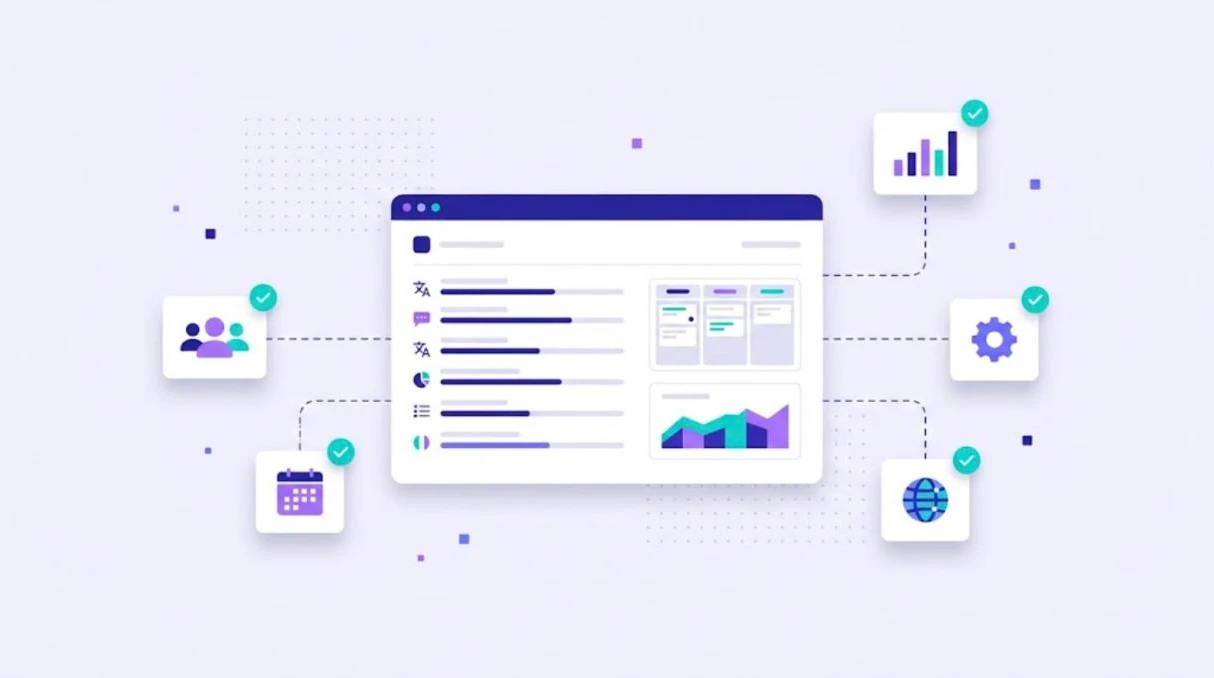
Localization management is the planning, coordination and control of all activities needed to adapt a product or content for new markets, from choosing languages and vendors to running workflows, quality checks and releases. It turns translation from a series of one-off requests into a repeatable process. This guide covers the roles, processes, tools and metrics of effective localization management.
What Does Localization Management Include?
- Strategy: which markets and languages to support, and in what order.
- Process: how content moves from source to translated and published.
- People and vendors: translators, reviewers, agencies and in-market stakeholders.
- Language assets: translation memory, term base, style guides.
- Technology: TMS, CAT tools, AI engines, integrations.
- Quality: review levels, QA checks and quality scoring.
- Budget and reporting: cost per word, turnaround, coverage and ROI.
Key Roles in a Localization Team
| Role | Responsibility |
|---|---|
| Localization manager | Owns strategy, budget, vendors and processes |
| Localization project manager | Runs day-to-day projects, schedules and deliveries |
| Localization engineer | Handles file formats, integrations and automation |
| Translators and reviewers | Translate, edit and review content |
| In-market reviewers | Check tone, terminology and cultural fit |
| Product, marketing and engineering | Provide source content, context and release plans |
For the day-to-day project side, read our guide to translation project management.
The Localization Management Process
- Intake. Content requests arrive from product, marketing or support, ideally through a single channel.
- Preparation. Files are analyzed against translation memory and prepared with context and instructions.
- Translation. Linguists or AI engines translate, guided by glossary and style guide.
- Review and QA. Automated checks run, and reviewers edit based on content risk.
- Delivery. Files go back to the CMS, repository or design tool.
- Feedback. Corrections update translation memory and glossary.
- Reporting. Costs, turnaround and quality are tracked over time.
Centralized vs Decentralized Localization
In a centralized model, one team manages localization for the whole company, which keeps quality and costs under control. In a decentralized model, each department buys translation on its own, which is flexible but leads to duplicated spend, inconsistent terminology and no shared translation memory. Many companies move toward a central platform with clear processes and let teams request work through it.
Tools for Localization Management
A translation management system is the core tool. It stores language assets, routes tasks to the right people, connects AI engines and integrates with code repositories and content systems. Workflow automation removes manual file handling, so managers can focus on quality and strategy instead of email and spreadsheets.
Metrics Every Localization Manager Should Track
- Cost per word after translation memory leverage.
- Turnaround time per language and content type.
- Translation coverage per release.
- Quality scores from LQA reviews.
- Edit distance on machine-translated content.
- Business impact: traffic, conversions and support tickets per market.
To estimate and control spend, see our article on localization cost.
Common Localization Management Challenges
- Content arriving late, with no time for translation before release.
- No single source of truth for terminology.
- Vendors working in different tools and formats.
- Limited visibility into costs and quality.
- Difficulty proving the ROI of localization to leadership.
Manage Localization With WordBeam
WordBeam gives localization managers one platform for projects, files, linguists, translation memory, term bases, AI engines and QA. Activity tracking and LQA scorecards on the Studio plan provide the data to report on quality and costs. Plans start at $25 per month, with a free 14-day trial; see WordBeam pricing.
Frequently Asked Questions
What does a localization manager do?
A localization manager owns the strategy, budget, vendors, tools and processes that adapt a company's products and content for international markets.
What is the difference between localization management and translation management?
Translation management focuses on the translation process itself. Localization management is broader and includes strategy, market priorities, cultural adaptation, testing and business results.
Do small companies need localization management?
Yes, even if it is one person with a simple process. A shared translation memory, glossary and tool save money from the first languages onward.