
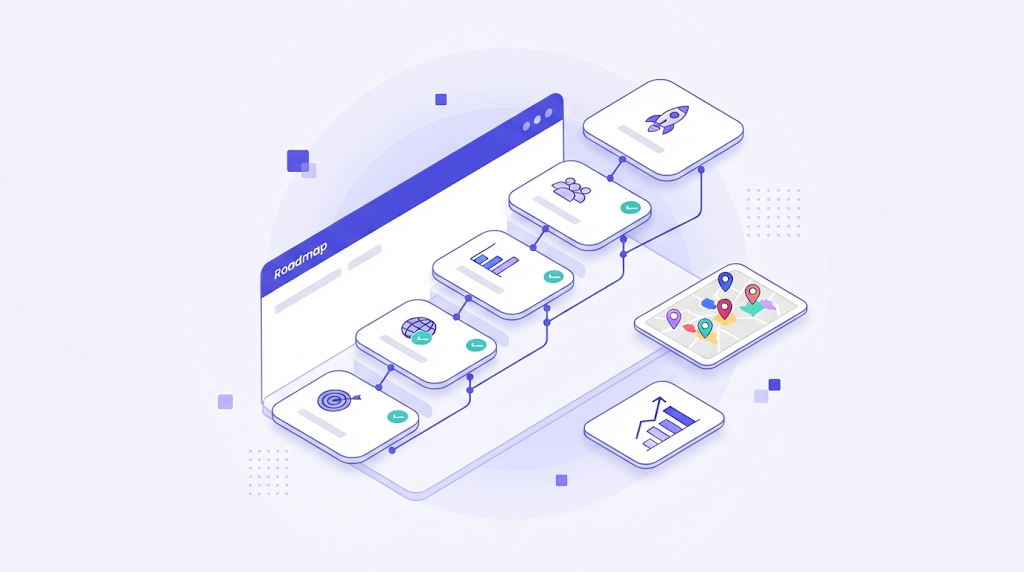
Most companies do not start with a localization strategy. They start with a request. Sales needs a German brochure, a big customer wants the app in Japanese, marketing launches a Spanish landing page. A year later there are translations in a dozen places, three vendors, no shared terminology and nobody can say what it all costs. That is the moment a strategy becomes necessary.
A localization strategy turns scattered translation requests into a deliberate plan for growth. This guide covers the decisions that matter and the order in which to make them.
What Is a Localization Strategy?
A localization strategy is a plan that defines which markets you will serve, which content you will adapt for them, how the work will be done and how success will be measured. It connects business goals, such as revenue in a new region, with the practical process of translating and adapting content and products.
Step 1: Choose Markets With Data
Start with evidence, not instinct. Useful signals include:
- Existing traffic, sign ups and revenue by country.
- Search demand for your product category in local languages.
- Competitor presence and pricing in each market.
- Regulatory requirements that make local language mandatory.
- Internal capacity for sales, support and payments in that market.
Group markets into tiers. Tier one gets full localization of product, website, marketing and support. Tier two gets the product and key pages. Tier three may get only the product interface, sometimes with machine translation and light review.
Step 2: Prioritize Content
Not every word deserves the same investment. Map your content by business impact and visibility:
| Content type | Impact | Suggested approach |
|---|---|---|
| Product UI, checkout, pricing | Very high | Professional translation and in market review |
| Website, landing pages, ads | High | Localization or transcreation with local SEO |
| Help center, documentation | Medium | Machine translation with human post editing |
| Internal and archive content | Low | Machine translation or English only |
For marketing pages, plan keyword research in each language from the start. Our guide to localization SEO covers the details.
Step 3: Decide on Your Team Model
There are three common models, and many companies combine them:
- Centralized. A localization team owns the process, vendors and tools for the whole company. Consistent, but can become a bottleneck.
- Decentralized. Each department or region handles its own translation. Fast, but often inconsistent and expensive.
- Hub and spoke. A central team owns tools, terminology and standards, while regional teams review and adapt content. This usually scales best.
Decide early who approves translations in each market. In country reviewers, often local sales or marketing staff, catch problems that no translator outside the company can see.
Step 4: Build the Right Technology Stack
Scaling localization without technology means scaling manual work. The core of a modern stack is a translation management system that connects to your content sources, stores translation memory and glossaries, runs quality checks and coordinates translators and reviewers. Around it, you add machine translation engines, connectors to your CMS and code repositories, and reporting.
Two assets compound over time and deserve attention from day one: a shared translation memory and a well maintained glossary. Our guide to terminology management explains how to build one.
Step 5: Automate the Workflow
When content changes daily, manual handoffs become the main source of delays. Workflow automation can detect new content, create projects, assign translators, route to review and publish without anyone sending an email. For software, connect your repository so new strings are translated continuously instead of in a rush before each release.
Step 6: Set a Budget That Reflects Reality
A realistic budget includes more than per word rates. Account for review time, project management, tools, terminology work and updates to content that has already been translated. Translation memory reduces costs over time, because repeated and similar content is paid at lower rates. Track those savings, since they are the strongest argument for continued investment.
Step 7: Measure What Matters
- Revenue, sign ups or conversions per market compared with the cost of localization.
- Organic traffic and rankings for localized pages.
- Time from source content publish to localized publish.
- Quality scores from reviewers and customer feedback.
- Translation memory leverage and cost per word over time.
Common Strategy Mistakes
- Launching too many languages at once and maintaining none of them well.
- Localizing marketing pages but not the product or support, which breaks the customer journey.
- Choosing vendors before defining terminology and quality standards.
- Treating localization as a one time project instead of a continuous process.
Frequently Asked Questions
When should a company create a localization strategy?
As soon as you translate regularly into more than one language or plan to enter a new market. It is far easier to set standards early than to clean up later.
Who should own localization?
Ideally a dedicated localization manager or team with support from marketing, product and engineering. In smaller companies, it often sits with marketing or product until volume grows.
How long does it take to see results?
Product localization can show impact within weeks of launch. Organic traffic from localized content usually takes several months to build.
A localization strategy that scales is built on clear priorities, shared assets and automation. Start with the markets and content that matter most, and design the process so the next language is easier than the last.