
"We need this translated" and "we need this localized" are often used as if they meant the same thing. They do not, and the difference shows up in results: a translated page can be perfectly accurate and still fail to convert, while a localized one feels like it was written for the reader. Understanding localization vs translation helps you brief vendors correctly, set the right budget and avoid content that is technically correct but commercially useless.
What Is Translation?
Translation is the process of converting text from one language into another while preserving its meaning. A good translation is accurate, fluent and faithful to the source. It focuses on language: words, grammar, terminology and style. For a full introduction, see our guide what is translation.
What Is Localization?
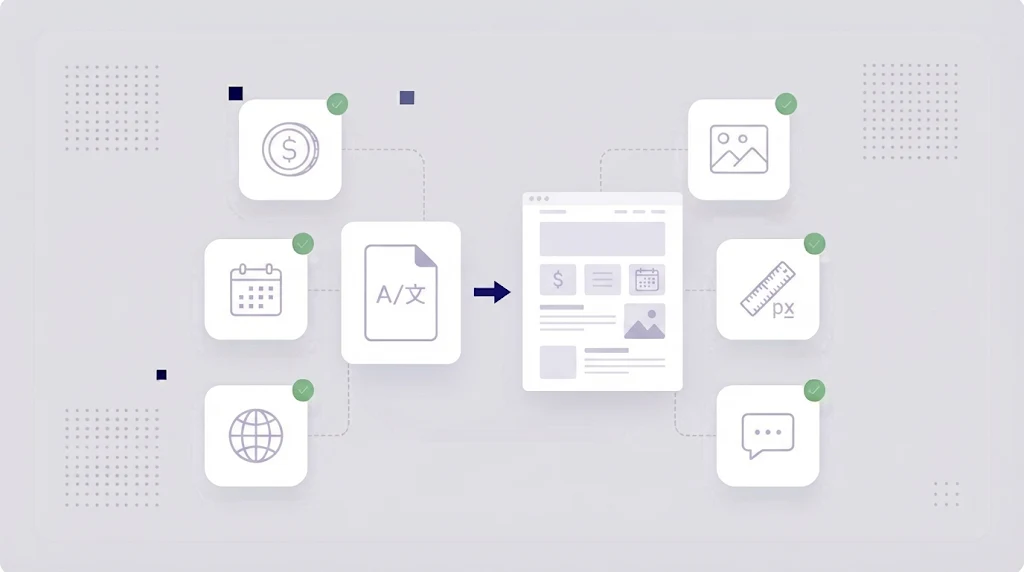
Localization (often shortened to l10n) is the process of adapting a product, website or piece of content for a specific market, so that it feels native to users there. Translation is one part of localization, but localization also adapts:
- Currencies, prices, taxes and payment methods.
- Date, time, number and address formats.
- Units of measurement and paper sizes.
- Images, colours, symbols and icons.
- Examples, names, references and humour.
- Legal content, compliance and privacy requirements.
- Layout, including space for longer text and right to left scripts.
- Keywords and SEO for local search behaviour.
Localization vs Translation: Side-by-Side
- Scope: translation covers text; localization covers the whole user experience.
- Goal: translation aims for accurate meaning; localization aims for local relevance and action.
- Who is involved: translation needs linguists; localization also involves developers, designers, marketers and legal reviewers.
- Typical content: translation fits documents, contracts and manuals; localization fits apps, websites, games, ads and products.
- Cost and time: localization takes more effort upfront, but delivers better engagement and conversion.
Examples of the Difference
A pricing page
Translated: "Plans start at $29 per month, billed on 03/04." Localized for Germany: prices in euros including VAT, the date written as 4.3., and the payment methods German buyers expect.
A mobile app
Translated: the interface text is in Japanese. Localized: the text fits the buttons, dates use the Japanese format, the onboarding examples feel familiar, and the App Store listing targets keywords Japanese users actually search for. Read our app localization guide for the full process.
A marketing campaign
Translated: the English slogan rendered word for word. Localized, or transcreated: a new line with the same intent and emotional effect in the target culture. See what is transcreation.
Where Internationalization Fits In
Internationalization (i18n) is the engineering step that makes localization possible: separating text from code, supporting Unicode, plural rules and flexible layouts. Think of it this way: internationalization prepares the product, localization adapts it, translation converts the words. Our article on internationalization vs localization explains i18n in detail.
When Translation Is Enough
- Legal documents, certificates and contracts where fidelity to the source is the priority.
- Internal documentation for employees who share the same context.
- Technical manuals with standardised content (see technical translation).
- Content where the source is already culturally neutral.
When You Need Localization
- Software, apps and SaaS products (software localization).
- Websites and online stores meant to generate leads or sales.
- Marketing, advertising and social media content.
- Games, eLearning and multimedia.
- Anything that has to rank in local search results.
How Technology Supports Both
Whether you translate or localize, the same tools make the work faster and more consistent. A translation management system centralises content, translation memory reuses approved sentences, a term base keeps terminology consistent, AI translation engines produce first drafts and QA checks catch errors. For localization, context such as screenshots, character limits and string keys becomes especially important.
How WordBeam Helps
WordBeam supports both document translation and full product localization in one workspace: Word, PowerPoint and InDesign documents, app strings, website content and subtitles. Teams set different workflows for each content type, from AI plus light review to full localization with in-context review. Start free and see the difference on your own content.
Frequently Asked Questions
Is localization more expensive than translation?
Usually yes, because it involves more adaptation, review and sometimes engineering or design work. It also tends to produce much better engagement and conversion in the target market.
Does localization include translation?
Yes. Translation is the core of localization, but localization adds cultural, technical and functional adaptation on top.
What does l10n mean?
L10n is a numeronym for localization: the letter L, followed by the 10 letters in between, and the letter N. Internationalization is shortened to i18n the same way.